
Business Solar Grants
For businesses across Hawke’s Bay, solar is no longer just a sustainability move, it’s a strategic financial investment. Through EECA co-funding, commercial green loans, and energy-efficiency programmes, many businesses can significantly reduce the upfront cost of going solar.
From retail and office spaces to manufacturing and warehousing, solar helps lower overheads, strengthen resilience, and demonstrate genuine climate leadership to customers. With electricity prices continuing to rise, locking in lower energy costs through solar gives businesses greater certainty over their operating expenses for years to come.
Hawke’s Bay’s abundant sunshine makes it one of New Zealand’s best regions for solar generation, meaning commercial systems here consistently perform well and deliver strong returns on investment. Whether you’re looking to reduce your carbon footprint, cut monthly power bills, or future-proof your operations against energy price volatility, solar is a practical and proven solution.
Many local businesses are already seeing the difference, shorter payback periods, improved cash flow, and a tangible story to tell customers about their commitment to a cleaner future. Now is the time to explore what solar can do for your business.

Why Hawke’s Bay Businesses Choose Solar
Energy security during peak seasons
Reduced operating costs
Strong sustainability credentials
Better resilience during outages or grid strain
Ideal roof space on large commercial buildings
Strong financial returns and predictable energy cost
Hawke’s Bay businesses have access to strong government support focused on reducing energy use and cutting carbon.
The Energy Efficiency and Conservation Authority (EECA) offers targeted co-funding and support mechanisms to help New Zealand businesses transition to a low-emissions future. While EECA does not typically fund standard commercial rooftop solar installations on a purely transactional basis, they actively co-invest in projects where renewable energy technology drives measurable energy innovation, sector decarbonisation, or demand flexibility.
EECA’s funding frameworks are designed to overcome initial financial barriers by sharing the investment risk. For qualifying commercial projects, support generally falls into four distinct categories:
Solar Energy Systems
Co-funding focused on high-replication potential, sector-specific demonstrations (such as the Solar on Farms initiative), or unique commercial integrations that prove technological viability.
Battery Storage & Demand Flexibility
Funding for intelligent battery storage solutions that enable businesses to participate in energy arbitrage, demand response networks, or support local grid stability.
Energy Efficiency Upgrades
Support for optimised systems (like smart inverters, HVAC, and commercial lighting) that ensure a business reduces its overall energy profile before sizing a solar array.
Electrification & Process Heat Projects
Subsidies aimed at shifting commercial operations away from fossil fuels (such as gas or coal-fired boilers) toward clean, electric alternatives powered by on-site renewables.
Most major banks now offer dedicated green lending products for commercial energy upgrades, accessible across a wide range of business types, offices, retail, warehouses, manufacturing sites and hospitality venues.
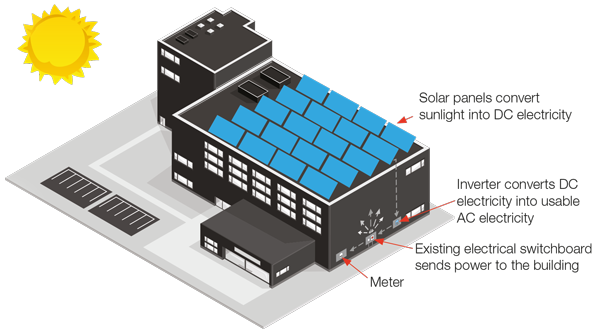
Funds can be used for rooftop solar, solar carparks, battery storage and EV charging infrastructure, either as standalone projects or as part of a broader energy strategy.
Many green finance products offer competitive rates and longer repayment terms compared to standard business loans. For businesses weighing up upfront costs, repayments can often be structured around the savings the system generates, meaning the loan can be largely self-funding from day one.
Speak with your bank or a commercial finance broker early to understand what products are available and what documentation you’ll need.
What people say about us

Very Professional Team. Had a Solar System solution specked ordered and installed by DMAK electricals for our off grid cabin. Very pleased with their service. Will be happy to use them again.
DMAK recently serviced my heat pumps. They arrived promptly and did a great job. They identified a fault, fixed it promptly and both are now running better than ever. I wouldn’t hesitate to call them again.
Vaughan Heeney